Monday, 19 November 2012

Robert Clack Media Past Student Analysis

In today's lesson after looking at professional thriller openings we looked at Past student thrillers from Robert Clack, we had to note down the negatives and positive of each clip.We watched 6 different clips

Night Walker
Positives
  • There was a good use of shots 
  • Framing - Feet/ High angle shot
  • The Pace and Music was appropriate to the scene taking place 
Negatives
  • The plot was to much of a cliché too obvious 
  • Opening Titles Font was Mundane and the font was typical 
  • The quality was low 
  • The diegetic sound was incorrect, surely if you were being dragged away      
The Night Walker
Positives
  • Acting was Convincing
  • You were really engaged and drawn to watch  
  • Diegetic sound 
  • Font was not typical and had a good effect 
  • Opening Scene was really creative and unusual
  • It had a cool ident
We didn't really find any faults with this opening we believed it was really good.
The Betrayal
Positives
  • Really good use of Diegetic sound 
  • Non linear narrative - includes a flash back 
Negatives
  • Font was too big for the frame 
  • Lighting- Was too dark 
  • Camera handling was too shaky
  • The black in white effect didn't look good   
Your Mine
Positives
  • Door Opening -creaking at the end 
  • Camera Shots 
  • Mirror shot 
  • Non-diegetic music appropriate (not all the way through)
Negatives
  • Font mundane 
  • Acting was unconvincing 
  • Pan was jerky 
  • Not much attention to detail
  • Non-diegetic sound 
Finders Keepers 
Positives
  • North by Northwest theme
  • Shot angles interesting 
  • Acting 
  • Man with phone 
  • Idea of a threat 
  • Non-diegetic sound 
  • Comic 
  • Free running 
Negatives
  • Font was mundane- Ariel 
As a Class our favourite was Finders Keepers because it was very engaging and worked at being a thriller by working outside of the guidelines it was very imaginative and convincing , some how it just works.

Monday, 12 November 2012

Title Openings

In today's lesson we started thinking about the start of our thrillers and the different ways we can make them effective thrillers we ended up talking about the techniques of professional films that were all classed as thrillers.We also started thinking of ideas but hadn't formally story boarded them.
Then we analysed why these thrillers were so effective and how the openings had an affect on us.
The professional films we looked at were Brick, Zodiac and a few more which varied in openings which lead us to believe there was terror from the beginning or that there was a suspicious element to the story  or had the totally opposite view.
When analysing opening titles we were told to think and take notes of what made the openings good and what aspects of the start made good thriller openings and about the Idents  that professional film makers use and what our ideas of one was
We were also told to consider and concentrate on these main things when making our own opening to a thriller and analysing the film clips we were going to watch:
  • Holding a shot steady
  • Framing a shot 
  • Using a variety of shot distances 
  • How is the shot material appropriate to the scene or film genre set 
  • Using key conventions   
1. A history of violence (2005) : 
This is an crime thriller, it is an adaptation of the graphic novel "A History of Violence" by John Wagner and Vince Locke in 1997.The film stars Viggo Mortensen,Mark Bello, Ed Harris and William Hurt. The main character played by Viggo Mortenson is Tom Stall he is the innocent owner of a diner that is put into the spotlight after killing two robbers in self-defence.
This opening scene is has a very unsuspecting and unsettling beginning, I have never watched this film but have read the whole plot and it is very well done because you think that theses two men are going to have a big significance within the film but they do not.
Some effects of this opening title was:
  • Slow paced and long shot- this was a really good effect during the opening scene because it had a tense build up and everything just seemed too suspicious to be innocent two men staying in a motel together with little conversation or a oblivious out look,also the long shot just show the two characters which make us believe they are the main characters in the film. It carefully manages the audience focus  and pulls our attention.
  • Contrast- It has a good use of contrast pulls a reaction from the false normalcy from the audience/viewer, we don't expect the ending of the opening scene in the part we watched  I haven't been able to find a clip that shows everything we saw but as I have said throughout the title opening  the acting is slow paced there is no music just continuity sound   but then as the calm scene goes on we see that it is actually a murder scene and this is a contrast to the way they are acting and what has actually happened this has an effect on the viewer because we don't expect a murder although we know that the characters are suspicious.
2. Zodiac (2007) 
Zodiac is a crime and mystery thriller, it is based on the true story of the Zodiac killer who was a serial killer during the late 1960's and the early 1970's leaving several victims and left letters taunting the police and the newspapers, using this symbol on every murder he committed. 
With great film stars like Mark Ruffalo, Jake Gyllenhaal and Robert Downy Jr, the main character played by Jake Gyllenhaal as a San Francisco cartoonist who becomes a amateur detective as he becomes obsessed by the Zodiac killer and tracking him down. 

Sadly I couldn't find the clip we watched to show the effects of the clip but I will say what was really good about the clip still:
  • Music and the Scene- This is the first thing we notice about the opening shot, first we hear pleasant up beat music and this gives us a happy atmosphere and just an all round happy theme then we have the shot that is very awkward and in some way creepy without the music as it is just showing the street from a car window and the journey the person is taking this has an aspect of mystery as you cannot see the driver and you are confronted with a  unrealistic view of the street.Also another Scene is the part when the couple are getting shot by the Zodiac killer,there is a pop-rock music on the radio and this is contrapuntal sound because it doesn't match the scene and has a false representation. 
  • Pacing and the settings- First of all at the start despite the music it is a very slow paced scene because it is as if the car is rolling down the street or about to stop  which is more natural but can also lead us to the unsuspecting ending of the extract also the fact that the couple make there way to "lovers lane" which is also contradictory as this is meant to a romantic scene in a romantic setting with a couple a forbidden love but it is full of tension and it is deserted so you already sense a sense of doom and as we know this is true as the couple are also on edge in the scene.  
We also analysed two other films that were also impressive,Brick and No Country for Old Men, Brick also had a slow paced start but No country for old men had a faster pace.
Brick :


No Country for Old Men :


Wednesday, 7 November 2012

Profiles: Alfred Hitchcock

At the start of the Course we watched Alfred Hitchcock films as an introduction to Thriller films as Alfred Hitchcock is said to be the most successful English thriller film maker and described as a "Cultural icon", I believed it would be valuable to research Alfred Hitchcock for some background information :
Alfred Hitchcock
Name: Alfred Joseph Hitchcock
Nicknames: Hitch & The Master of Suspense.
Born: 13 August 1899, in Leytonstone, London(England)
Died: 29 April 1980, in Bel Air, California(United States) at 80 years old
Occupation and Years active: Film Producer and Director, Active from 1921-76
Main Genre Specialist: Suspense and Psychological thrillers 

Finished Films
The 1st film we watched from
Alfred Hitchcock
The Pleasure Garden (1925) 
The Mountain Eagle (1926) (lost)
The Lodger: A Story of the London Fog (1927)
The Ring (1927)
Downhill (1927)
The Farmer's Wife (1928)
Easy Virtue (1928)
Champagne (1928)
The Manx-man (1929)
Blackmail (1929)
Juno and the Paycock(1930)
Murder! (1930)
Elstree Calling (1930)
The Skin Game (1931)
Mary (1931)
Rich and Strange (1931)
This was the third film we watched from
Alfred Hitcock.         
Number Seventeen (1932)
Waltzes from Vienna (1933)
The Man Who Knew Too Much (1934)
The 39 Steps (1935)
Secret Agent (1936)
Sabotage (1936)
Young and Innocent(1937)
The Lady Vanishes(1938)
Jamaica Inn (1939)
Rebecca (1940)
Foreign Correspondent(1940)
Mr. & Mrs. Smith(1941)
Suspicion (1941)
Saboteur (1942)
Shadow of a Doubt(1943)
Lifeboat (1943)
Aventure Malgache (1944)
Bon Voyage (1944)
Spellbound (1945)
Psycho was the 2nd film we watched from
 Alfred Hitchcock .
Notorious (1946)
The Paradine Case(1947)
Rope (1948)
Under Capricorn (1949)
Stage Fright (1950)
Strangers on a Train (1951)
I Confess (1953)
Dial M for Murder (1954)
Rear Window (1954)
To Catch a Thief (1955)
The Trouble with Harry (1955)
The Man Who Knew Too Much (1956)
The Wrong Man (1956)
Vertigo (1958)
North by Northwest (1959)
Psycho (1960)
The Birds (1963)
Marnie (1964)
Torn Curtain (1966)
Topaz (1969)
Frenzy (1972) 
Family Plot (1976)

The highlighted film names are the ones we watched in our lessons on Alfred Hitchcock

Themes and Plot Devices in Alfred Hitchcock Films
Hitchcock represents many cinematic devices but Hitchcock's main Genre/Device is suspense and thrillers, Alfred Hitchcock is mostly well-known for his MacGuffin but he is also known for being a successful and one of the best British Film director, even with his silent movies and his early "talkies".Hitchcock framed all his thriller films and film editing to maximise anxiety, fear and empathy.
Within the Plot there are normally fugitives on the run and encounters a normally "blonde" fem fatale, they normally have a twist in the ending that is also linked to Hitchcock's Psychological approach to thriller films which also allows us to understand why there is normally more in terms of analysis to the psychological health of Hitchcock's characters.

Television, Radio, and Books
Television: Hitchcock was among the first prominent motion picture producers along with Walt Disney to to imagine how television would become popular.Hitchcock also was the host of of a television series although associated with suspense the series portrayed Hitchcock as darkly humorous but yet again made him instantly recognised. 

Books: As Hitchcock became so popular  he appeared as a character in other well known detective book series, Also Hitchcock's name was licensed for a monthly magazine called "Alfred Hitchcock's Mystery Magazine". Hitchcock also wrote a mystery story for Look magazine in 194, the sequence encouraged the reader to piece the Murder/Mystery together.  

Radio: Hitchcock also had a radio series called "The late Alfred Hitchcock presents" which was broadcast by BBC Radio 7 which ran for 15 minute sessions, but was actually an impersonation of Alfred Hitchcock.

Tuesday, 6 November 2012

The Birds

In this lesson we watched another Thriller/Horror Directed by Alfred Hitchcock.
The Birds was made in 1963 and it run for 119 minutes  the original story was written by Daphne Du Maurier (picture 1) and the screenplay was written by Evan Hunter (picture 2)


The main stars of The Birds was Rod Taylor as Mitch brenner,Tippi Hendren as Melanie Daniels and Suzanne Pleshette as Annie Hayworth.
The plot of The Birds: A wealthy San Francisco socialite pursues a potential boyfriend to a small northern Californian town that slowly takes a turn for the bizarre when birds of all kind suddenly begin to attack people there in increasing numbers and with increasing viciousness.

The difference between The Birds and the two other Alfred Hitchcock films is because now the external threat is from nature and this is something we can definitely not prevent or stop this is a bigger effect because this is bigger than anything a normal human comprehend and as birds are normally admired in certain cases. The film allows you to accept the possibility of an actual attack and this may scar people as it is a thought that is out of our hands. 

Thrillers are normally  characterised by fast pacing and frequent action and although in The Birds there are parts where it is calm through out the film during the bird attacks it is fast paced and the fluttering of the birds add an not only a agitating but an irritated  panicky sound making us aware that something is abnormal  such as in the birthday scene or the school scene.


Thrillers are also seen with heroes that swart the efforts of the enemy and although in The Birds the towns people are unsuccessful  they do try to protect one another and try to keep the birds out of there houses  the person who puts the most effort in is Mitch Brenner  as he tries to make people believe that what Melanie is saying is true and his efforts on securing the house from the birds although it only lasted a few seconds,also he is always quick to react allowing us to think that he is a hero because he dominant acting as a leader  and knows what to do to lead people to safety.

A thriller has always had a a villain driven plot  where they present obstacles for the hero to overcome in the case of The Birds it is a lot harder to identify but  the obstacles we can see is to find safety from the birds and how they are to defeat them obviously the birds wouldn't think like this but this is what the towns people need and they are trying to gain control again some of the towns people try to cope with the events by denying that the birds are attacking oblivious to the harm they have already caused linking this to the MacGuffin  Melanie's original thoughts were to secure a boyfriend this is what we believe is the original plot  but as time within the film moves forward you see that the attacks are stopping the couple from being together although Mitch does look after Melanie and the whole point of the film is about the birds that are attacking humans although they are unsuspecting creatures. The whole point of a MacGuffin or the defining aspect of it is that the main characters are willing to do/ sacrifice almost anything to obtain an acquaintance and in this case Melanie sacrifices herself by telling Mitch not to come into the room to save her and she does this by actually travelling far enough to be with him.

The specific nature of the MacGuffin is to be ambiguous, undefined ,generic ,left to open interpretation or otherwise completely unimportant to the plot in this case survival is the MacGuffin as they are trying to live and escape from the attack  but the plot was about finding love initially  but the MacGuffin isn't be related to the plot also another example is that birds are not in the plot neither was the potential threat and the fact is that its open to interpretation therefore making it unexplainable and playing the MacGuffin card.
MacGuffins are most common in thrillers  but are used in other genre of films and can not be used. MacGuffins decline in importance as the motivations of the characters can come through  but then it can pick up again when there are scenes of high climax,Alfred Hitchcock defined the MacGuffin as the object around which the plot revolves,but, as to what that object specifically was he said "the audience don't care".


Some unrelated Knowledge
In the scene above where Melanie is attacked by the birds in the attic near the end of the film took a week to film, the birds were attached to her clothes so they could not get away and would constantly fly toward her to look like they were attacking her, this was done with the film featuring 370 effect shots and the final shot is a composite of 32 separately filmed elements.Also Tippi Hedren was cut in the face by a bird in one of the shots during the film and told people that Alfred Hitchcock never told her what she was to expect in the scene above and because of this she had a bird phobia.

The End
There were many alternative endings thought for the film one of them apart from the one actually featured was the Golden Gate Bridge completely covered by birds, I think this would be a good ending as it gives us a sense that humans do not dominate the word it is birds  are everywhere grouping together becoming united against the human race.
At the end of the film Alfred Hitchcock did not put the customary "The End" because Alfred Hitchcock wanted the viewers to believe and give the impression of  unending terror and as if the birds will follow where they go this also links to the alternative ending.

Music
Although there is no soundtrack/ musical score for this film there were sounds created on the mixtrautonium, which is a early electronic musical instrument, of the children singing in the school that also adds dry humour as we know something is definitely wrong but the children are oblivious and are singing a song.
To add further effect when audiences left the films UK premier  they were greeted with the sound of screeching and bird wings fluttering commissioned by Alfred Hitchcock himself by putting loud speakers into the trees to scare the viewers further also supporting the fact that there is no "The End".

Alfred Hitchcock's aim in all his thriller is to be true to his words that thrillers are to allow the audience "to put their toe in the cold water of fear to see what its like".Alfred Hitchcock has succeeded as in any other of his he  creates a threat but the most thrilling and horrifying aspect of this film is that in real life birds are everywhere we have just naturally expected them to calm animals that anger us but with this film we can imagine what the birds feel  as we scare them the thrilling aspect is actually if birds retaliated we would have no control although we have weapons I don't personally believe that we would win against birds even though it seems fake you cannot doubt the possibility that it may actually happen.

Tuesday, 16 October 2012

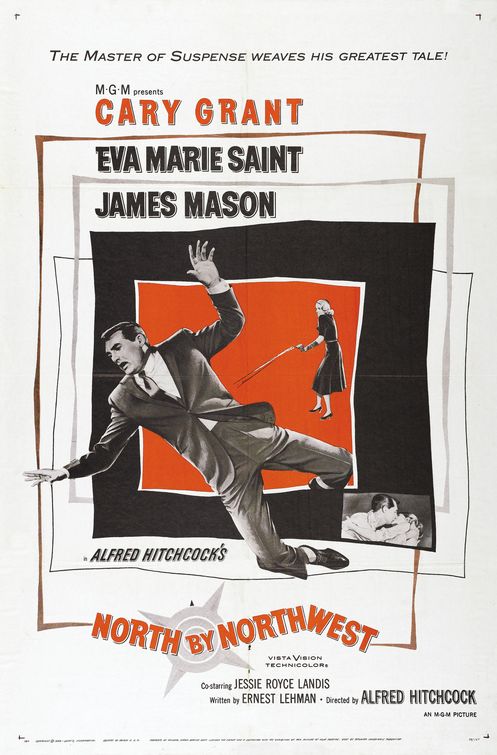
North by Northwest

In every Tuesday session we watch an Alfred Hitchcock Thriller.
As an introduction we began with North by Northwest
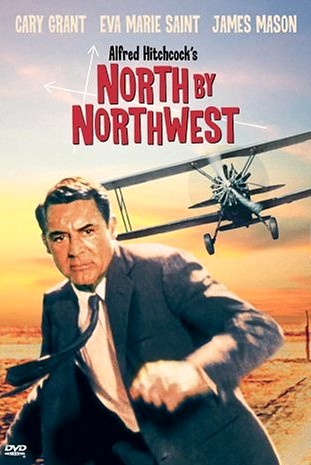
The Screen-write from Ernest Lehman and Directed by Alfred Hitchcock in 1959 and with great stars such as Cary Grant and Eva Marie Saint as main characters.

A "innocent"  New York advertising executive (Cary Grant) is mistaken for a government agent by a group of foreign spies, and is pursued across the country while he looks for a way to survive.

The Trailer
 The first thing that grabs your attention in this trailer is the Music this is appealing because the Music sounds mysterious and all-round makes you want to watch more.Also it shows all the main thrilling scenes without telling the viewers  what happens next  it send a shiver down your spine which allows you to already know the film will be a thriller and the Voice over man also uses word like "sinister"which is thrilling as you cant help but think  what else will happen so much information flies your way and over whelms you making you crave the ending.

Archetypal Thriller
An Archetypal thriller is defined by the following quotations from Alfred Hitchcock himself with these quotations I will be linking them to north by north-west and how they apply to there titles:
  1. "Thrillers are characterised by fast pacing and frequent action"- this quote applies to North by Northwest because North by Northwest has many scenes such as the plane and the Car Chase as is all Car chases it is fast paced and the music adds frequent tension the fact that shots blend in together is a really good effect because it adds an air of mystery and worry for Cary Grant that he may be injured within such a small amount of the film this also makes us want to watch more as we know Cary Grant is "drunk" and in that case making us curious of how he is going to get out of that situation. I've found a Clip of the scene I meant but unfortunately it is of low quality.
  2. "Resourceful heroes who must thwart the plans of the more powerful and better equipped villains" - this quote applies to North by Northwest because we consider Cary Grant and in some way Eva Marie Saint a hero although they are caught in tricky situations they seem to over come them for example when they are both in the train and Eva hides Grants character at the top of the cabin as she stole the key from the guard this is seen as heroic because no one expects the woman in the film to be able to do that the Fem fatal is seen as a women who is pretty, she is heroic because she can become a role model, also Cary Grant is heroic as he thwarts the plans of the villain to kill him for example with the plane scene,we see Cary Grant run into a corn field this was him trying to have a disguise so the villains could not trap or see him he chooses the corn field because it was convenient  for him and this makes him a hero successfully delaying the villain and not falling for there trap.(The crop duster scene will be analysed further.The clip is bellow)
  3. "A thriller is a villain driven plot,whereby he presents obstacles the hero must over come" above is the scene to the car chase this applies to this statement because the villain contributes to many obstacles that are designed to trap or harm Cary Grants character as we said earlier the car chase scene is one of the main  obstacles Cary Grant faces as he is his own worst enemy if he cannot get control of the car he will die and in that case the film would have been finished before it had even started but luckily the character swerves past the attempts of the villain and makes sure he is caught by the police and steers his car so he doesn't fall down the cliffs surprisingly to the villain.
  4. "Devices such as suspense, red herrings and cliffhangers are used extensively "- this applies to the North by Northwest as it uses these devices a lot and as all these devices come together to add a lot of effect and complement each other.The best scene to look at for this definition is the auction scene as it has a wide use of all three devices:
  • Suspense :The device suspense is used frequently in this scene and throughout the film such as the side road scene and the car chase but as we see in the Auction clip (above) as we see we have the Villain slowly and steadily stroking of Eva's head and then the shot shows the audience very slowly this builds suspense as we wonder When Cary Grants character will appear as he knows the "truth"and then we see that Cary Grant is actually witnessing what is happening,this scene fills us with suspense not only because we want to know when he will appear but it is also gives us the idea of deceit and hurt which makes us wonder how Grants character is going to react. 
  • Red herrings:A Red herring is a clue that intentionally allows the viewer to be mislead from the main issue the Red herring in this scene is two things  first is the character Eva Saint is playing obviously before we thought she was an ally and now in this scene she is with the Villain but then by the end of the film we realise she is actually a Secret agent, but the main Red herring is the fact that they seem to be at a art auction but are actually looking out to by the statue with the drugs in them this counts as a red herring because we believe that although the Villains must be doing something wrong they are just innocently buying/viewing pieces of art but the reality is that they are buying a type of drug this is hidden away from the audience until a little later when we find out there real intentions making this a Red herring Scene.
  • Cliffhangers :The Cliffhanger within this scene is that we realise that Cary Grants character has fallen into a trap and we wonder how he will get out of this situation he is in, we realise that the character has fallen in an unintentional trap and has in fact trapped his self this also add to my earlier point that all these devices complement each other in this case suspense and cliffhangers go hand in hand.
    The Crop Duster Scene 
The Crop Duster scene is one of the most Iconic action sequences within the film as it has the ability to have all we want in a thriller in the short clip:
  1. Firstly we see the plane flying by and we consider it just an ordinary plane as does Cary Grants character and then we see that it is really going  towards Cary Grant and that whoever is flying the plane is trying to get him, within the small part we get a point of view shot of the pane going toward Grant and this allows us to be in Grants place as if the plane was coming towards us.This builds panic and tension and overall interest in the audience as you want to know what will happen to the character and you would like to know who is in the plane, As point of view shots allow you to see what the character is seeing we truly feel that we have put our "toe in the cold water of fear" because we can put ourselves into that scene and see how we would react.
  2.  As we realise this is an obstacle the Villain has presented to Cary Grants character it builds up the tension we feel,we are already tense from knowing that Grants character is looking for someone by the side of the road and then we see that actually it was a plan to trap or kill Grants character this makings us think that there are forces against Grant and that the villain has an upper hand as does all villains this also leads us to believe that Grant will not be able to get out of the circumstance he is in.
  3. When analysing a scene we have to take into consider the surroundings and setting the scene takes place, Within North by Northwest there are many good scene settings but looking at the Crop Duster scene there are many factors to the setting that add an effect to the audience first of all earlier than the clip shown there is a very empty road during that scene all you can suspect is for a car to come, the car Grants character is looking for but all there is a dusty side path and a very quiet road this adds to  the tense feeling because you expect a high action scene but although it is very slow with little action it still adds tension as if it is slowly creeping into a adrenaline filled scene, There is also the Crop scene where Grants Character hides within the crops this adds an effect as we quickly think of a primal scene and that Grants character is fighting/ hiding for his own safety and survival this effects the audience because we are given the mind set that something very serious is happening and that its so life risking that there is a need to hide but the fact that there is the lone crop field in the middle of no where gives us the idea that Grants character is alone in this world of villains and enemies. 
  4. Then there is the scene where he has to fall on the dusty paths this is an effect as Grants character is a business man and we do not expect him to be in the middle of crops all dusty this is is effective because as I have said in the earlier point it makes him primal and desperate, desperate because he is doing anything to stay safe/alive even if that does mean throwing himself to the floor and getting his clothes dirty 
  5. The Main reason the Crop Duster scene is very iconic is because it has an amazing action scenes that are able to fill you with suspense and slow seeming fast paced action ,First you have the plane throwing the dust bombs , this is an iconic action scene because its is fast paced due to the running of Grants character  and the diegetic sound effects coming from the planes motors and the dust bombs and an air of urgency but the Non diegetic sound at the running scene adds a lot of tension. Then there is the scene when the plane crashes into the truck, Grants character seeks an escape and see there on coming truck but the truck is unable to stop causing screeching and the explosion sound as the plane goes into the truck. Overall this is a thrilling scene made to make our hearts beat outside our chest
MacGuffin

MacGuffin is "a plot element that catches the viewers attention of drives the plot of a work of fiction."The defining aspect of a MacGuffin is that the major characters in the story are (at least initially) willing to do and sacrifice almost anything to obtain it, regardless of what the MacGuffin actually is.In fact,the specific nature of the MacGuffin may be ambiguous, undefined ,generic,left to open to interpretation or otherwise completely unimportant to the plot examples of an MacGuffin is money ,glory,survival,a source of power,or a potential threat, or it might be something totally unexplained.A MacGuffin is common in films and especially thrillers.commonly,though not always ,the MacGuffinis the central focus of the film in the first act ,and then declines in importance as the struggles and motivations of the characters play out.It may come back into play at the climax of the story, but sometimes the MacGuffin is actually forgotten by the end of the film.In TV interviews Hitchcock defined the a MacGuffin as the object around which the plot revolves but, as to what that object specifically is,he declared "the audience doesn't care".In North by Northwest's case we could say the MacGuffin what the Villains are in possession of which is the drugs.

Alfred Hitchcock said Thrillers allow the Audience "to put their toe in the cold water of fear to see what its like" Alfred Hitchcock successfully achieves this within every thriller film he has made but within North by Northwest he does in the scenes above  and the cliff hanger scene, and with his many different devices.

While watching an interview of Alfred Hitchcock it seems his philosophy is that thrillers are meant to be dreamlike and even a nightmare but real enough to shock and scare as if it could actually happen,He also believed that narratives made the storyline /thriller more smooth for the audience to catch on but a dream would be disjointed, I understand Hitchcock's theory on this as if you have a daunting dream sometimes the person dreaming cant even make sense or even understand it as Alfred Hitchcock wanted to make thrillers able in reality he had to make them a narrative. A strong device he mentions in his interview is avoiding a cliché this is the most effective device Hitchcock could possibly use as whatever thriller we look at  you don't expect the ending from the films that we actually have watched the strongest film we have seen with this factor was psycho, the ending was totally unexpected as throughout the film you
are led to believe that the character is still alive,Within the clip below Alfred Hitchcock explains how he made this scene seem like a cliché but more like reality within 3:44 and 7:40.
This clipped interview is beautiful because you can see the amount of passion within his answers an explanation of his devices such as Mystery, defying cliché and suspense.  

Psycho

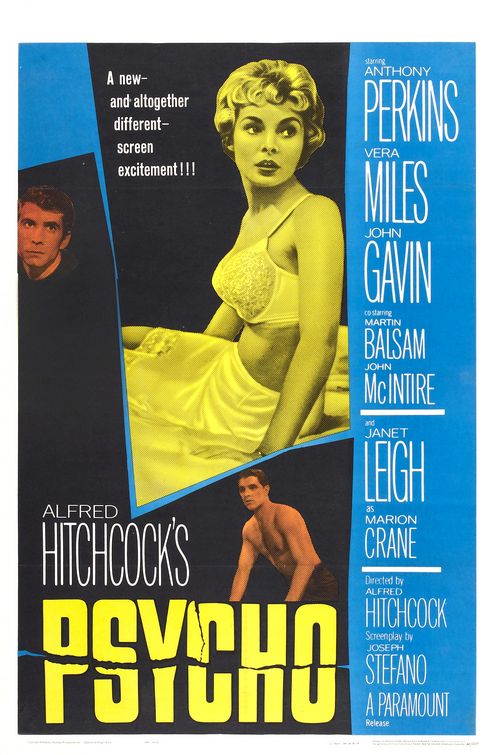
Today we watched the film from the Director Alfred Hitchcock called Psycho, the film was made in 1960 None of the other Alfred Hitchcock films have had as much as an impact as Psycho on American psyche.and it was a large Box office hit and as time has moved on to be a big fascination in the american society as they experienced something so different,Psycho was such a big hit hat there was a remake in 1998
Originally Psycho was a Novel by Robert Bloch (picture 1), then made into a screenplay by Joseph Stefano (picture 2) who accepted but then denied the chances to do The Bird (1963) and Marnie (1964) both from Alfred Hitchcock.

In psycho there were many famous film stars the three main stars and their characters are Anthony Perkins as Norman Bates, Janet Leigh as Marion Crane and Vera Miles as Lila Crane

The plot of Psycho contains a MacGuffin (A plot device that leads you to believe there's a original plot when there is another motive within the fictitious storyline) for example the plot of Psycho is, Marion Crane a office worker in Phoenix is fed up with the way life has treated her,forced to meet with her secret lover through her lunch breaks since he would have to pay alimony if they wed, suddenly Marion steals $40,000 from her employer's client and subsequently encounters a motel owner who has been too long under the domination of his Mother.
As we watched the film we realised that the real threat isn't Marion Crane but a deranged mind ,a mad "man".
A thriller is described as a fast pacing and frequent action there are many examples at which this is present in psycho:
the most famous scene in the world is the Shower scene from psycho which also made Janet Leigh even more famous


Within this scene there is a slow start which we know can build up attention just as well as as a fast pace  because Marion is always moving although not fast she is always in motion but the main part is when she is getting stabbed you can tell something is going to go wrong  but the fast pacing of the attack adds more effect, we need to keep an eye on the motion of the knife and Marion trying to protect her self  then we look at the effect of the music and how the blood trickles down the drain and the shower curtain being pulled off one by one these all cause an effect making us jumpy  another scene that does this is the staircase  it also starts off very slow causing suspicion while he is walking up the steps and becomes fast paced at the end of the scene when he is falling down the stairs,yet again the pace of the music has added effect


Thrillers are also defined by their resourceful heroes who thwart the plans of more powerful and better equipped villains.within psycho there is no obvious hero but if you really look at what each character does I think you can identify a hero in my opinion Sam Loomis and Lila Crane are the heroes,Although the true heroic action comes close to the end of the film I have this opinion because Sam and Lila  never give up the search for his lover/her sister  and in the End scene they make a brilliant plan to find out what is going on which they succeed in even though there are aspects that make us feel the character for example Lila Crane is being foolish for trapping her self but unconsciously to us and the character  we are being led to the truth then when we see the skeleton and Norman in his mothers clothing Sam is holding Norman back, disarming him and in the end put him into prison this is heroic as Sam is resourceful and thwarts Normans plan to also kill Lila.


Another way Thrillers normally have devices that cause effect this is suspense red herring and cliff hangers are used frequently
Psycho hasn't got an amazing plot it is actually pretty basic but the construction of the film  that develops the film Alfred Hitchcock has done a very good job with certain scenes such as the shower and stairs scene you see above as these both bring shock to the viewer,makes us think psychologically and doesn't contain our own expectations always surprising us. if the viewer has no idea what is to happen within the film they will experience the force of Alfred Hitchcock's device and why he intended this.The most unbelievable detail of the film is when Marion Crane is killed because through out the start of the film we are lead to believe she is a main role this is an example of the screenplay tricking us.
When this film was in theatres they were not allowed to enter any other time apart from at the start of the film  Alfred Hitchcock planned this as he didn't want the order of the film to be compromised or anyone to believe the main character is Norman Bates.This also leads to the element of suspense and how it is used in Psycho below is a scene which really builds suspense in a lot of aspects such as Music,what we see.


The first aspect of this scene that fills us with suspense is the Music because in the background  it seems like a violin or an cello  these instruments are always used to make a tense scene where you feel its right to be suspicious also the pace of the music is fast making it an intense scene as it puts our nerves on edge
Another aspect is what we see one of the main effects on me is the link between the title Psycho and the look Marion has within this scene like a psycho she smiles at normally unpleasant thoughts her ideas of what the other characters are saying a made up from her head,anyone can imagine someone else's thoughts but the most mentally ill people assume people are talking about them making them paranoid,look included allows us to feel that something is wrong with this character instantly making us wary of  her making us think she is the Psycho. Also we see that a rain starts in this scene this gives us an idea that the journey she is going on isn't as simple as it seems and that it is unclear where she is going  this is supported by  the reaction of Marion when she cannot see the road as she reacts in panic this also makes us believe that she may have a crash or any other difficulties.

A thriller normally always has a villain involved presenting obstacles in this case we are initially made to believe that it is Normans mother who is the villain but it is actually Norman himself  even though we are oblivious to this we are shown with subliminal messages that we are not aware of until we a shown showing this is the picture bellow the fact that there are stuffed Birds everywhere allows us to believe that Norman is dangerous and a predator  it also supports the fact that Norman likes to preserve dead things not for beauty but to remind him for example his mother, the obstacles that Norman presents is hiding information or clues from the seekers of the information for example he cleans up Marion's dead Body and when he pushes the car into the swamp these are ways Norman causes obstacles as it isn't helping or isn't leading the investigator to the real truth.

Alfred Hitchcock said that a thriller must allow the audience to "put their toe in the cold water of fear to see what its like" I would say Alfred has succeeded in countless scenes within the film  because many times within the film I reacted felt a kind of fear that was thrilling yet interesting and I'm sure if more people had seen this film they would agree and people who are reading this blog and have watched it are probably thinking about there reactions to Psycho, there are many devices used such as on and off screen sound that have a on going effect that gives us an insight to what will happen but despite this we still have a reaction this is because of  Alfred's architectural approach to the common film , we cannot forget about the main scenes in this film that are shown above "Psycho is a brilliant excursion into fear that pushes many of our primal buttons" this is a review that also expresses my view.

The shower scene
If you have seen Psycho the scene that comes to mind is the shower scene and the first images we see is of the attack on Marion  this scene, even if you haven't seen the film you have been told or are aware of it. as  we have said before music is one of the main reasons why a scene has a high effect in this case it is Bernard Herrmann's strident, discordant  music has been used in many other films to add an appearance of a psycho.


Brilliance in any scene lies within amazing editing in Psycho a lot of the editing is left imagined as we only have been hinted Alfred Hitchcock's intentions.
In the shower scene we see a knife ,blood which is actually chocolate syrup,water and a woman's naked body but separately we see the body is concealed strategically and we do not see the blade sink into the skin all we do see is the brief stab and we hear the blade sink in but the rest is our imagination making the scene full in our minds,basically filling up the gaps  this is another reason others may consider Psycho mild compared to today's thrillers and horrors as they depicted as gruesome and very graphic.
Some extra information is that after Psycho was released it was said to spawn a group of people who had Ablutophobia which is a phobia of bathing/ showers  this is because Psycho made there viewers understand how truly vulnerable they are while they take showers this led them to start taking baths a victim of this phobia was Janet Leigh her self  she claimed after the film she never took a shower again.

Editing in film

Today we talked about how to edit a clip or a film. 
Then we were told about some key words we would need to learn about:
Splicing: this is cutting shots of a film then putting it into the order you want it to be in.
Speed of Editing: This is how long each shot lasts. Speed can also determine the current mood in the film for example if it is a fast paced scene/shot it could be perceived as someone being in panic.              
Style of Editing: This is how each shot is joined to the next one for example by blackouts or fades.


Then we watched to clips from Bourne Ultimatum (BU) and Sleepless in Seattle (SIS) and were told to count the shots in the one scene from both we all found that the escape scene had more shots than SIS which made the scene tense allowing us to determine that this was a chase scene and someone is in trouble or has done something wrong comparing this approach to Psycho and the shower scene found that the constant switching of shots in the shower scene also makes us tense and fearful for the character. 

Style of editing
 As we were told earlier Style of editing meant how each shot is pieced together with the next shot but we were given more vocabulary we may need in our written exams or for knowledge in general such as transition, which is the movement from one shot to the next.
With the main topic being transition we talked about straight cut and dissolve which also falls under that heading.
Straight cut: This is the most used transition as it is invisible it is not obvious to the viewer as it moves without drawing attention, in that case making the scene look professional rather than cheep.
Dissolve: This is a shot that dissolves into the other shot in turn this causes an effect that you can see both shots during the dissolve and this can be used to show connections or a subliminal message. For example below in the clip between 1:29 and 1:32.


Fading: This is gradually darkening or lightening the shot until the image becomes black or white, Fading emphasizes the end of a shot or the ending of the film or can show the passing of time.
Continuity Editing  
Continuity Editing gives us a further understanding and it keeps the film realistic and chronologically realistic and in order this generates the feeling that time is moving forward. Continuity Editing may use Flashbacks, Flash forwards and linear narrative these all progress the film in a natural and realistic way.

Preliminary Task: 
In our preliminary task we will need to show our filming skills this includes: graphic match this is when two shots dissolve into each other that have an object of the same shape and size allowing it to flow together these can be done at two different angles.

We will also take another shot showing that the character is looking at something off screen then take  another shot that is zoomed in to the object they are looking at.

Match on action - We see a character start an action in one shot and then see then continue it in the next scene.

Graphic match- The film can choose to place shots in a certain order to create a smooth visual transfer from one frame to another, when two consecutive shots are matched in terms of the way they look for example, in Psycho the shower scene Marion's eye and the shower plug look similar and has been made into a graphic match. 
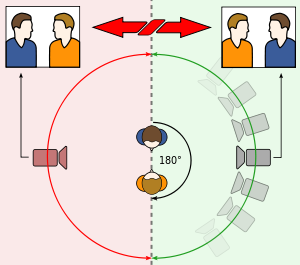
The 180-degree rule- The 180 degree rule is a guideline that states that two characters (or other elements) in the same scene should always have the same left/right relationship in each other. If the camera passes over the imaginary axis connecting the two characters/subjects, it is called crossing the line. 
When editing a conversation you have to start with a master shot, a master shot is a shot when you can see all the people in the conversation and then when you want individual shots of different characters you can go into single shots which is called a cut away shot but also we need to consider that you don't always have to see the person currently talking this links into the effects we can use.
Story boarding : 


^ This is a template of a storyboard                                                      ^ This is an actual storyboard 

A pointer when story boarding is that each shot is one of the boxes and if you want to differentiate between characters story boarding normally uses the type of hair the characters have and what way they are facing.